


You've found a paper that's relevant to your research. Should you look at the papers it cites, or the papers that cite it?
The answer depends on what you're trying to find. Backward citation search helps you uncover the research a paper was built on, while forward citation search reveals the newer studies that built on it.
Both methods are valuable, but they serve different purposes. In this guide, you'll learn the difference between backward and forward citation search, when to use each one, and why combining both leads to a more comprehensive literature search.
Both directions are part of how citation networks work. If you're new to the concept, start with our guide to citation networks before diving into the differences between backward and forward citation search.
Here's a quick comparison before we look at each method in more detail.
What is backward citation search?
Backward citation search means looking at the references of a paper you already have.
Every paper you read was built on earlier work. Its reference list is a record of that work, the studies the authors read, relied on, and considered important enough to cite. When you follow those references, you're tracing the intellectual lineage of the paper: where its ideas came from, what evidence it built on, and which foundational studies shaped the argument.
The term "backward" refers to direction in time. You start from a paper published in, say, 2022, and follow its references back to 2018, 2010, 2001 -- further back with each step.
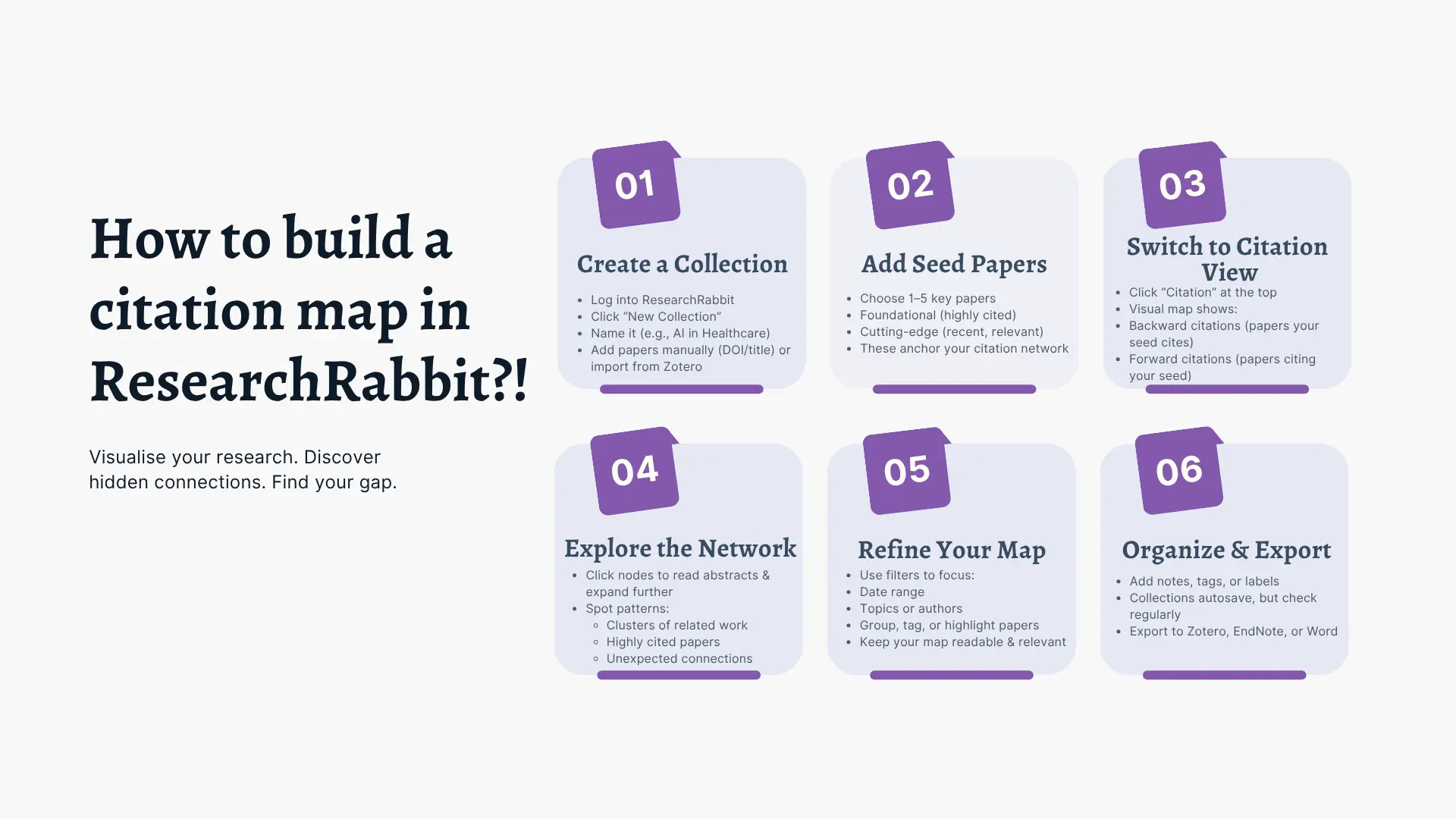
In ResearchRabbit, backward citation search is what happens when you select References for any paper. It maps everything that paper cites, visually, so you can see which foundational papers appear repeatedly across multiple papers in your collection.
Backward and forward citation search are both methods of exploring citation networks. If you're new to the concept, our guide to citation networks explains how citation networks work and why they're useful for discovering papers beyond keyword search.
Other names you might see: reference searching, citation mining, pearl growing, chain searching, bibliographic mining, snowballing (backward).
What is forward citation search?
Forward citation search means looking at who has cited a paper since it was published.
When a paper gets published, other researchers read it and cite it in their own work. Following those citations forward takes you to the research that built on the paper, the studies that extended its findings, applied its methods, challenged its conclusions, or used it as a foundational reference.
The term "forward" refers to direction in time. You start from a paper published in 2010, and follow its citations forward to 2015, 2019, 2023, closer to the present with each step.
In ResearchRabbit, forward citation search is what happens when you select Citations for any paper. It surfaces every paper that has cited it, with scannable abstracts so you can quickly assess whether each citation is engaging with the paper supportively or critically.
Other names you might see: cited reference searching, forward citation tracing, citation tracking, snowballing (forward).
When to use backward citation search
When you're new to a topic and need foundations. Starting from a recent paper you trust and following its references backward is one of the fastest ways to identify the foundational literature in an unfamiliar field. The papers that appear repeatedly across multiple reference lists are almost certainly the ones your field considers essential.
When you're tracing how an idea developed. If you want to understand the intellectual history of a concept, how it was first proposed, how it evolved, where the key debates happened, backward search is the tool. Each hop takes you further back in time, closer to the origins.
When your keyword search is returning recent papers only. Search algorithms favor recency. If your results are clustered in the last five years, backward search from those papers will surface the older foundational work that's being cited but not appearing in search results.
When you need to establish theoretical grounding. For dissertations and systematic reviews, backward search helps you demonstrate that your literature review engages with the foundational work in your field, not just the most recent publications.
When to use forward citation search
When you need to check if a paper is still current. A highly cited paper from 2008 might have been substantially updated, challenged, or superseded by later work. Selecting Citations in ResearchRabbit and scanning the abstracts of papers that cite it tells you how the field has engaged with it since publication, whether it's been built on, refined, or contested.
When you're in a fast-moving field. In areas like machine learning, genomics, or climate science, the literature moves quickly. Forward search from foundational papers surfaces the most recent work building on them, which is often more relevant to your research question than the foundational papers themselves.
When you want to find the current state of a debate. If a paper made a controversial claim, forward search reveals how the field responded. Papers that cite it to agree look different from papers that cite it to argue against it. Scanning abstracts quickly gives you a read on where the consensus sits.
When you've identified a key foundational paper and want to see its influence. Some papers are so foundational that following their citations forward maps a significant portion of the field. Selecting Citations for a landmark paper often surfaces papers you'd never find through keyword search, particularly recent work that uses different terminology.
Using backward and forward citation search together
The most comprehensive literature searches use backward and forward search together, from the same starting paper.
Here's why: a paper sits at an intersection between what came before it and what came after. Backward search shows you one side of that intersection; forward search shows you the other. Together, they give you a complete picture of where a paper sits in the conversation of a field.
For example, suppose you're studying CRISPR. Backward citation search quickly takes you to the foundational discoveries that made gene editing possible. Forward citation search reveals newer clinical applications, ethical discussions, and technical improvements that built on those discoveries.
A simple workflow is:
- Start with one to three papers you know are relevant
- Run References from each, follow backward to identify foundational work
- Add the most relevant foundational papers to your collection
- Run Citations from those foundational papers, follow forward to find recent work building on them
- Add what you find and repeat from the new papers
Each iteration expands your search beyond your original starting papers and surfaces research that would be difficult to discover through keyword search alone. This is why most systematic review guidelines recommend combining backward and forward citation searching rather than relying on either method alone.
Choosing the right approach for different research contexts
Established, stable fields (history, philosophy, classical economics, literary theory)
In fields where the foundational literature is well-established and slow-moving, backward search tends to be more productive. The key papers are older, well-cited, and unlikely to have been superseded. Forward search is still useful for finding recent applications or re-interpretations, but the foundations matter most.
Fast-moving fields (machine learning, genomics, climate science, certain areas of medicine)
In fields where the literature moves quickly, forward search becomes essential. A paper from 2019 might already describe a landscape that's changed significantly. Forward search from that paper tells you what has developed since, and whether the 2019 paper is still the right reference to cite.
Interdisciplinary topics
When your research sits at the intersection of two or more fields, both directions matter, but for different reasons. Backward search uncovers the foundational literature from each discipline; forward search surfaces the recent cross-disciplinary work that connects them. Similar search in ResearchRabbit adds a third angle: finding papers that are co-cited alongside yours, which often surfaces the cross-disciplinary connections that neither backward nor forward search alone would find.
Systematic reviews
Systematic review methodology explicitly recommends both forward and backward citation searching as complements to keyword search. Backward search surfaces older relevant work; forward search captures recent publications that cite your included studies. Both should be documented in your methods section.
A note on scope
Both backward and forward search can expand quickly. Following every reference in every paper you find would take months. The goal isn't exhaustive coverage, it's strategic coverage.
A few principles that help:
Prioritize papers that appear repeatedly. When the same paper appears in the references of multiple papers you've already found, that's a signal worth following. In ResearchRabbit's citation map, centrally positioned papers are the ones to prioritize.
Use abstracts to filter before you follow. You don't need to read every paper to decide whether to search from it. Scan the abstract. If it's genuinely relevant, search from it. If it's peripheral, note it and move on.
Stop when you start seeing the same papers. When backward and forward searches consistently surface papers you've already found, you've mapped the core of your literature. The process has a natural endpoint.
Getting started in ResearchRabbit
If you have one paper you're confident is relevant, you have both starting points you need.
Select References to follow connections backward, to the foundational work that paper was built on. Select Citations to follow connections forward, to the recent work that built on it.
Then add what you find and repeat from those papers too. Each iteration expands the network and surfaces papers that neither keyword search nor a single hop would have found.
Start your citation search in ResearchRabbit →
FAQ
Is backward citation search the same as snowballing? Snowballing is a related technique used in systematic reviews that involves manually following reference lists. Backward citation search in ResearchRabbit automates this process and visualizes the connections, making it faster to follow multiple reference trails simultaneously.
Can I do forward citation search in Google Scholar? Yes, the "Cited by" link under any search result shows papers that have cited it. Web of Science and Scopus also support forward citation search with more filtering options. ResearchRabbit maps both directions visually from any paper in your collection.
Which is more important, backward or forward? Neither is universally more important. It depends on your research question, your field, and where you are in your review. Backward search is usually the right starting point for understanding a field; forward search becomes more important when you need to verify currency or find recent developments.
How many hops should I go? There's no fixed number. Go until you start seeing the same papers repeatedly, that's usually the signal that you've mapped the core of your literature. In practice, most of the most valuable papers live within two to three hops of your starting seeds.
What's the difference between forward search and Similar search in ResearchRabbit? Forward search (Citations) finds papers that directly cite your paper. Similar search finds papers that are frequently co-cited alongside your paper, papers that the field treats as intellectually related, even if they don't directly cite each other. Both are useful; they surface different types of connections.
%20(800%20x%201036%20px).webp)


_cover.webp)

This is a big test comment on your article.